
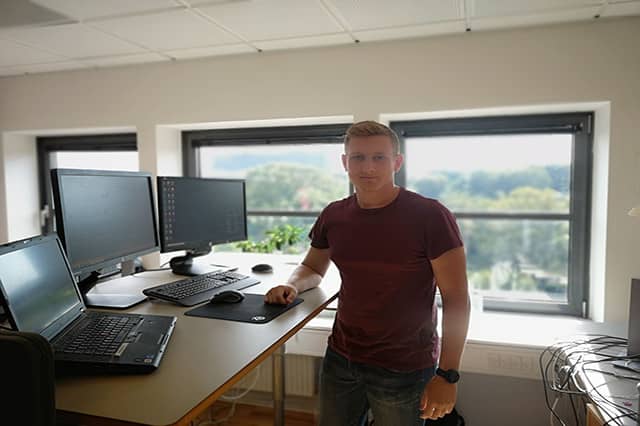
Georgi Ovalov
Center of Excellence for Health, Immunity and Infections, Rigshospitalet
After a short and not very encouraging ‘romance’ with another agency, Georgi accidentally found out about us from a post on the internet. Keeping almost daily correspondence with him for more than 3 months, answering his questions with diligence and diligence, he was accepted in his desired specialty – Multimedia Design at Business Academy Aarhus. Four years later, he has already completed his bachelor’s degree with a specialization in Web Development. He is currently starting his master’s degree at Aalborg University – Campus Copenhagen. Georgi works part-time as a Web developer in one of the departments of the largest hospital in Denmark – Rigshospital. He is one of our students, where we can see with the naked eye the incredible transformation from a confused young boy into a purposeful young man, who has grown a lot with his hard work over the years. We often ask him questions related to his favorite city Aarhus! There is nothing to hide, he helped us a lot with the construction of this site and the portal that you will use if you apply in Denmark with our help!
How did you decide to get your higher education abroad? And why did you choose Denmark?
Initially, in the 10th grade in high school, I had no intention of studying abroad. I had just moved from Shumen to Sofia and I thought that when I enrolled at Sofia University I would turn the game around. However, in my new class, I met a lot of intelligent and purposeful people, who later on went to study in different countries in Europe. It was them, who greatly influenced my choice. And why exactly Denmark? I will not hide that my original destination was Sweden. However, after a few meetings with people from an agency in Sofia, things did not seem so promising to me – there were not many people who were going there and the information was scarce. One of their consultants suggested that I should look at Denmark as an option – a lot of IT programs in English of all kinds. At that time I had a friend, who was studying in Aalborg, I asked him a lot of questions and he explained me in great detail everything I needed to know. Then I found my true self – the program I wanted to apply for. I got to know about Dan-Bul Study from a Facebook ad, contacted them, and everything else is history.
What were the benefits of this decision?
The benefits of this decision are so many. I would call it my best decision so far. Denmark will not only give you knowledge and education, guys. Denmark will be like a demo military training as I like to describe it, because you will find yourself in a place, where you will initially be alone, you will be confused, but then you will create your best memories, friendships and moments.
What were some of the difficulties that you had to face?
The difficulties are many, especially in the beginning, I will not lie. The funny thing I remember right now is that when I first landed in Copenhagen airport, I couldn’t buy a train ticket to Aarhus from the red ticket machines. Then Anton, although quite secretly and without introducing himself, helped me big time to buy myself a ticket, very lucky that he was traveling to Denmark on the same plane and was with me at that moment. Other difficult moments were finding a job, sometimes the job itself, but in general everyone from university teachers to friends will be especially friendly with you and will offer you help.
How did you cope with the culture shock? What was it like?
At first, everything seems damn cool. You are drifting in the clouds, this period lasted for about 3 months. Then you get used to it and start to feel the difference, to notice the disadvantages of where you are… However, all this is completely normal, you just need to be aware of it. You get used to it once you start sharing with the other people.
Tell us about your university. What did you like?
In the first place, Business Academy Aarhus gave me a completely different idea of the learning process that was formed by working in groups with other people. Maybe this approach is what I liked the most. You can always learn something from the other people around you. We were mostly students from Europe. The Danes were in the Danish programs. Another thing I liked was the excellent facilities and opportunities offered to students. Study rooms, a library, an innovative building and everything you need to feel good as a student.
What is the ratio between theoretical and practical skills that you gain at your university? To what extent would this help you in a real work environment?
It was a mix of the two with a mostly practical focus. Usually the teacher was making a presentation. After the lunch break, you try the new material in the form of exercises. In my opinion, this is the absolutely right mixture that puts you in such a real work environment (most often working on the problems of real companies, which means that real business problems are solved).
Tell us a little about the life in your city?
Although I moved to Copenhagen for my master’s degree, Aarhus will always remain in my heart. Aarhus is a student city as big as Varna, where you will find everything you need to call it your home, as I and many of my friends have called it over the years. As a university city, you can expect many events happening all over the city, as well as an international environment. Finding a part-time job in the beginning can be defined as relatively easy if you really put in the effort. Quite an important thing is the networking that you will create in the city. In many cases, it will be of great help to you.
Can you find a student job and is it easy to balance with the studies?
As I have already said, yes, it is relatively easy to find a job if you search hard and ask around. The balance depends a lot on the type of work, but it is usually about 2 days a week, which you need to get the SU, so don’t consider this a problem. However, you might have to miss different parties from time to time, it all depends on what job you have. I personally delivered newspapers and parcels, during my student days, and now during my master’s degree, I started working as a web developer, in one of the departments of the largest hospital in Denmark – Rigshospitalet.
How do you cope up with the costs here? Did you need financial support from your parents?
In the beginning I started with a capital provided by my mother, but after I found a job and started getting SU. I never needed money again. It’s nice to have parental support until you find a job, but after that your parents can feel at ease about the finances. For example, during my bachelor years, I was able to visit 20 countries with friends from the university, all thanks to the SU and my salary.
What is the student life like in Denmark? What opportunities do you have and what do you miss?
The student life in Denmark is mostly how you make it. The possibilities are countless, it depends on your interests. The parties are brutal, but don’t expect anything like our native reality with chalga, a certain type of people and so on. Here people go to have fun and really do it. I can’t think of anything specific that I’m missing right now. The student life in Denmark I would say is a unique experience!
Do you have any recommendations for the students, wondering whether to get their education abroad and are most likely to face problems similar to yours? What can they do to protect themselves?
Personally, my advice is to try something new and different while you are young, do believe in your skills. Studying abroad is not nuclear science and you can get so many advantages. You can always return to Bulgaria, if this is not your thing and continue there. There is no way to completely protect yourself from problems, just be strong, chart your path, set your goals and whenever you face adversity, remember why you are doing it.
Blog
No Results Found
The page you requested could not be found. Try refining your search, or use the navigation above to locate the post.